About the taverna
A Greek taverna on Sushchevskaya
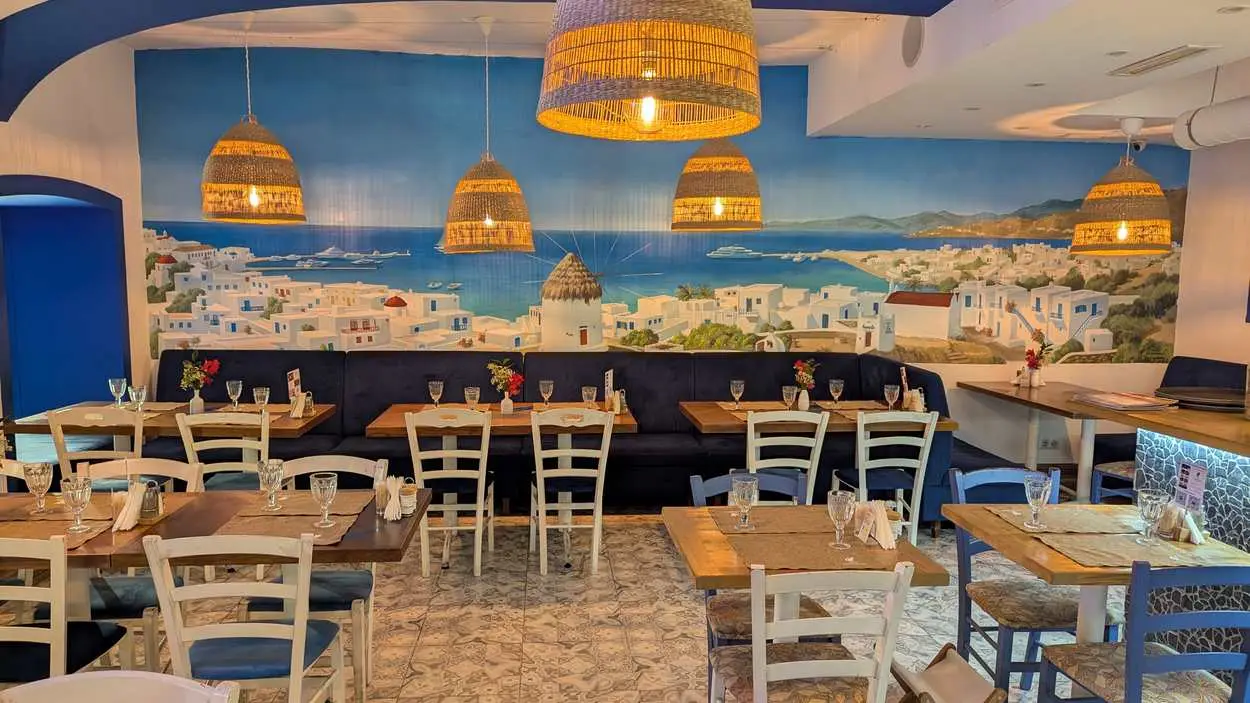
Porto Mykonos has been in the same place since 2016 — at 27/2 Sushchevskaya St., five minutes from Mendeleevskaya metro and seven from Novoslobodskaya. It is not a restaurant in the usual sense but a taverna: noisy, generous and homely, the way it is in Greece.
The hostess — Elen
The taverna has a hostess — Elen, a Greek woman. She greets guests herself, talks to them in Greek and Russian and makes sure no one leaves hungry. Elen is often in the dining room: she comes over to the tables, suggests what to order with the meze and congratulates birthday guests.
Her words became the taverna's motto: «In a restaurant you are served — in a taverna you are welcomed».
Philoxenia — why «welcomed»
The Greeks have a word, φιλοξενία — philoxenia, «love for the guest». A guest in a Greek home is not a customer but someone who was expected. They get the best seat, everything in the kitchen goes on the table, and no one rushes them. That is how our taverna works too: big portions, dishes in the middle of the table for everyone to share, long conversations and no hurry. We don't divide guests into «a table by the window» and «a banquet» — we welcome everyone just as warmly.
The kitchen: from Crete to Macedonia
Our recipes come from all corners of Greece: Cretan, Macedonian, from the islands. We keep it honest: if it's feta, it's real feta; if it's olive oil, it's top quality.
Meze — the start of the feast. In Greece meze are not just starters but a way to sit at the table for a long time. They go in the middle of the table for everyone: tzatziki made with thick strained yoghurt, fava from yellow split peas, taramosalata, melitzanosalata from roasted aubergines, dolmadakia in vine leaves, spicy tirokafteri from yoghurt and feta. With them — warm pita. Two people usually order three or four meze.
Cheese. There is no Greek table without cheese:
- feta with olive oil and oregano;
- feta bouyiourdi, baked with tomatoes and peppers;
- halloumi saganaki, fried to a golden crust;
- grilled halloumi;
- kalitsounia — Cretan pastries with feta and honey.
And of course horiatiki — the classic village salad: tomatoes, cucumbers, peppers, onion, Kalamata olives and a big slab of feta on top.
Lamb. The taverna's signature dish is arnaki sto fourno, oven-baked lamb. The chef chooses the meat himself and slow-cooks the shoulder for several hours with herbs and spices until it falls off the bone. We make it every day, but there is only so much — by evening it may be gone. More lamb dishes:
- kleftiko — lamb baked in parchment;
- paidakia — grilled lamb chops;
- merida with lamb.
Sea and grill. Grilled octopus on a bed of fava, whole dorado, shrimp saganaki in tomato sauce, mussels. From the grill — souvlaki and meridas of chicken, pork and beef, bifteki and a big meat platter for the whole group.
Sweets and coffee. Loukoumades — hot doughnuts in honey syrup with walnuts. Galaktoboureko — filo pastry with a delicate custard. Orange portokalopita and kunefe. After dessert — coffee on sand, brewed the Greek way in hot sand, and in summer cold frappé and freddo, without which no Greek kafenio is complete.
Ouzo, tsipouro and Greek wine
With meze the Greeks drink ouzo — an anise spirit from the island of Lesbos. It is mixed with water and ice, and it turns cloudy, milky white. There is also tsipouro — a grape spirit, and mastiha from the island of Chios.
Greek wines are made from local grape varieties you will hardly find outside the country:
- white — Moschofilero, Malagousia, Retsina;
- red — Xinomavro from Naoussa and Agiorgitiko from Nemea.
House white, red and rosé wine is served by the glass and by the carafe — as in any village taverna.
Five evenings — five tavernas
In Greece every taverna has its own character. Ours changes with the day of the week:
- Monday — Mezedopoleio, meze night;
- Tuesday — Mageirio, oven dishes day;
- Wednesday — Psarotaverna, fish night;
- Thursday — Psistaria, grill day;
- Sunday — Kafenio, cocktail night.
On evenings from Sunday to Thursday, Friends of the Taverna get special prices on the dishes of the night.
Friday and Saturday: dancing and plate smashing
On Fridays and Saturdays from 21:00 the taverna turns into a Greek celebration. The dancers bring guests up from their tables into one big circle — sirtaki, hasapiko, dances where everyone holds on to each other's shoulders. You don't need to know anything: we'll show you the moves, and everyone dances — from children to grandmothers.
And then — plate smashing. In Greece plates are smashed for good luck, out of the overflowing joy the Greeks call κέφι — «kefi». We use special safe plates for this, and we clean up the pieces ourselves. For an evening like this it is best to book a table in advance, for 20:00–20:30.
Celebrations and recognition
The taverna follows the Greek calendar: Ohi Day, Clean Monday, Orthodox Easter with Easter lamb. For birthdays, weddings and gatherings of 10–60 guests we have the Big Table, and since 2016 we have been bringing Greek food to parties and offices — that is our catering service, Porto Dilos.
In 2020 the Greek organisation Greek Taste Beyond Borders gave the taverna the title Ambassador for Greek Gastronomy — an official representative of Greek cuisine outside Greece. In 2023 we confirmed it and received three awards of the international Ambassadors of Taste Grand Prix.
Porto Mykonos is a Greek taverna in Moscow where guests are welcomed. Come in — we have lamb today.